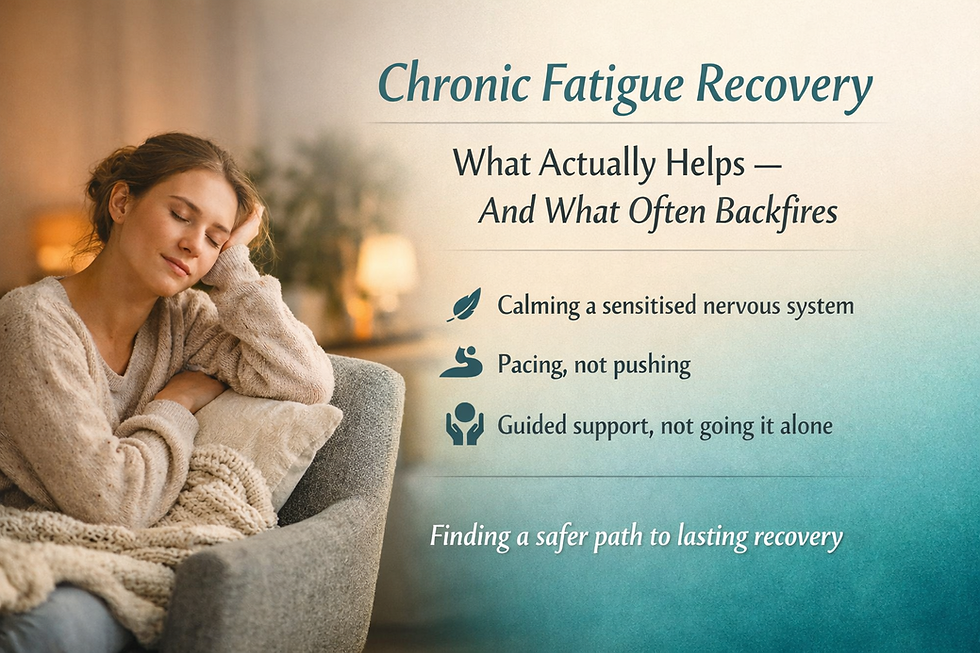
What Helps Chronic Fatigue and Long COVID — and What Often Backfires
- New Pathways Programme
- Jan 29
- 7 min read
Updated: Apr 13

If you’re searching for what helps chronic fatigue or Long COVID, you may already feel overwhelmed by conflicting advice. Some sources say rest more. Others say push through. Many promise a missing fix — yet nothing seems to stick.
This guide explains what actually helps chronic fatigue and Long COVID, what often backfires, and why a calmer, safety-first approach tends to work better for long-term recovery.
Quick answer: what helps chronic fatigue and Long COVID
When people ask what helps chronic fatigue, the answer is rarely a single treatment or quick fix. Recovery is usually about helping the body move out of a state of ongoing biological threat and back into a state of safety.
What helps most people is not endless rest or pushing harder, but regulating the nervous system so the body’s tolerance for activity can gradually increase. When invisible stressors are reduced — such as constant symptom-monitoring, pressure to recover quickly, and repeated Post-Exertional Malaise (PEM) cycles — the system often has more capacity for repair and adaptation.
This guide reflects the same calm, safety-first principles used in the New Pathways Programme, which supports people to stabilise first, then rebuild capacity without repeated crashes. 👉https://www.newpathwaysprogramme.co.uk/theprogramme
How to use this guide (and share it, gently)
This article is written for people around the world who are looking for what helps chronic fatigue and Long COVID, often while exhausted, anxious, or unsure which advice to trust.
You don’t need to read it all at once. Many people find it helpful to:
read one section at a time
return to it over days or weeks
use it as a reference, not a checklist
If you share it with someone else — a friend, family member, clinician, or support group — it’s often enough to share one idea or section, rather than the whole article.
This guide focuses on patterns that show up globally in chronic fatigue, post-viral fatigue, and Long COVID, regardless of country or healthcare system.
How recovery from chronic fatigue usually unfolds
In practice, what helps chronic fatigue recovery tends to follow a few overlapping stages, rather than a straight line.
Stabilisation: the first step in what helps chronic fatigue recovery
This involves reducing the frequency and severity of crashes by identifying your current energy baseline and staying within it more consistently.
If you’re unsure whether crashes or symptom flares are part of post-exertional malaise, this guide explains PEM in plain language and why it matters for recovery.
Regulation: calming the nervous system in chronic fatigue
Gentle somatic tools — such as slow breathing, vagus nerve support, or calming routines — help reduce nervous system hyper-vigilance and lower the background “threat level”.
For a deeper look at how brain fog and fatigue are linked to nervous system regulation, this article explores the mechanisms and what tends to help.
Capacity building: what helps chronic fatigue without crashing
Once stability improves, activity can be expanded gradually and safely, without repeatedly triggering the alarm response.
Re-engagement: returning to life based on safety, not willpower
People begin to re-enter life activities guided by felt safety and confidence, rather than pressure or fear of falling behind.
The paradox: why common advice about what helps chronic fatigue often backfires
Many well-meant recovery strategies can unintentionally keep the nervous system on high alert, using energy rather than restoring it.
Fatigue isn’t just low energy — understanding what helps chronic fatigue recovery
Chronic fatigue (including CFS/ME) and Long COVID fatigue are not the same as ordinary tiredness. They involve changes in energy regulation, immune signalling, and nervous system function. Treating fatigue as something to push through often leads to Post-Exertional Malaise, where symptoms worsen after activity — sometimes for days.
Why effort, pressure, and urgency often backfire
Urgency activates the fight-or-flight response. When recovery is framed as “I must get better now”, the nervous system interprets this as threat, diverting resources away from repair and regulation.
The role of the nervous system in ongoing fatigue
The nervous system constantly assesses safety. In chronic fatigue states, this system becomes sensitised — interpreting activity, stress, uncertainty, or even hopeful future plans as potential danger. This ongoing vigilance helps maintain the fatigue cycle.
If you’re trying to understand whether your symptoms reflect burnout, chronic fatigue, or a combination of both, this comparison may help clarify the differences.
What often doesn’t help chronic fatigue (and can quietly make it worse)
These patterns are understandable — especially when you’re trying to protect yourself — but they can unintentionally reinforce fatigue.
Micro-managing recovery
Constantly tracking symptoms, energy levels, steps, or “doing recovery right” keeps the brain in evaluation mode. Although it feels responsible, this rarely helps chronic fatigue recovery and often increases exhaustion.
Constantly searching for answers about chronic fatigue
Endless Googling, forum reading, or chasing the next explanation can increase uncertainty and anxiety. The search for reassurance becomes another drain on energy.
More information doesn’t always create more safety.
Comparing yourself to others
Comparing symptoms or recovery timelines — especially online — often triggers fear, guilt, or hopelessness. Other people’s stories are easily interpreted as threats by a sensitised nervous system.
Other people’s symptoms are not predictions about your future.
Forcing recovery or pushing too early
Aggressive graded exercise or push-through approaches frequently worsen outcomes for people with PEM, reinforcing the body’s fear of effort and movement.
Waiting to feel completely safe before living
At the other extreme, waiting for zero symptoms before re-engaging with life can shrink the nervous system’s window of tolerance, making progress harder over time.
What actually helps chronic fatigue and Long COVID recovery
Recovery usually involves a shift in relationship with energy, symptoms, and effort.
Creating safety and predictability: a foundation of what helps chronic fatigue
Consistent routines, gentle rhythms, and calming practices send signals of safety to the brain, allowing it to stand down from constant protection.
Reducing boom-and-bust patterns — what helps chronic fatigue without shrinking life
This isn’t about doing less forever. It’s about smoothing energy use so activity becomes steadier and more sustainable.
Gentle, consistent inputs: what helps chronic fatigue more than pushing
Short, frequent, manageable activities (“little and often”) tend to be far more effective than infrequent bursts of effort.
Responding to symptoms without alarm — a key part of what helps chronic fatigue
Symptoms are signals, not emergencies. Responding with neutrality and curiosity helps reduce the fear response that amplifies fatigue.
Re-expanding life gradually: how what helps chronic fatigue builds confidence
Small, supported steps rebuild trust in the body and confidence in daily life.
If you’re looking for reassurance that progress is possible without pushing or forcing recovery, these client stories reflect steady, safety-led change over time.
What this approach to chronic fatigue recovery doesn’t mean
This doesn’t mean your symptoms aren’t real
Fatigue, pain, and cognitive symptoms are real biological experiences.
This doesn’t mean it’s “all in your head”
This approach is grounded in neuroscience and physiology, recognising that brain and body form one integrated system.
This doesn’t mean rest or medical care are wrong
Rest remains essential for managing PEM. This approach complements appropriate medical care — it doesn’t replace it.
Who this approach to what helps chronic fatigue is most useful for
If you feel stuck, cautious, or afraid of setbacks
This framework prioritises safety and reduces pressure.
If you’ve tried pushing — and it’s made things worse
Your experience makes sense. This approach works with your system, not against it.
If tests are “normal” but life isn’t
It offers a recovery framework when investigations don’t explain why fatigue persists.
Many people reach this stage after being told their tests are “normal” — this guide explains why fatigue can still persist and what can help next.
How the New Pathways Programme supports recovery
Guidance instead of guesswork
A clear, structured approach so you’re not constantly second-guessing yourself.
Structure without pressure
A roadmap that removes urgency and supports steady progress.
Support when things wobble
Ongoing guidance to help you stabilise quickly after flare-ups.
When to seek medical input or additional support
Always consult your healthcare provider before making significant changes to activity levels. Ensure other potential causes of fatigue — such as anaemia, thyroid conditions, or nutritional deficiencies — have been appropriately assessed.
Frequently asked questions
What helps chronic fatigue and Long COVID actually improve over time?
Many people experience meaningful improvement by shifting from fighting fatigue to building capacity safely through nervous system regulation and pacing.
What helps chronic fatigue if I keep crashing?
Crashes usually indicate your current energy envelope is being exceeded. Stabilisation and regulation come first.
Is nervous system work really what helps chronic fatigue long term?
It works best alongside medical care, nutrition, pacing, and appropriate support — not in isolation.
A final note
People around the world search phrases like “what helps chronic fatigue”, “what helps Long COVID fatigue”, or “why does rest not fix fatigue”. While details vary, recovery often begins when pressure reduces and the nervous system feels safe enough to adapt again.
Sometimes clarity is the first form of relief.
About the author
I’m Steve Fawdry, a therapist and health coach, and the founder of the New Pathways Programme.
Since 2007, I’ve supported 700+ adults, teens, and families dealing with persistent fatigue patterns — including chronic fatigue (CFS/ME), post-viral fatigue, and Long COVID. Much of my work focuses on people who feel stuck, cautious, or afraid of making their symptoms worse after repeated setbacks.
My approach is neuroscience-informed and nervous-system-based, drawing on clinical experience, current understanding of neuroplasticity, and years of observing what actually helps people stabilise and rebuild their lives — and what quietly keeps them stuck.
I don’t believe recovery comes from pushing harder, ignoring symptoms, or endlessly searching for the “right” answer. Instead, I’ve seen again and again that progress tends to happen when pressure reduces, safety increases, and the nervous system is given the right conditions to adapt.
The principles in this guide reflect both my clinical work and what clients consistently report helps them move forward in a calmer, more sustainable way.
Next steps, if you want them
If this guide resonated and you’d like personalised support, you can book a free consultation with me — no pressure, just a calm conversation.